

GitHub Is the AI Operating System Hiding in Plain Sight
The best tool for managing organizational knowledge in the AI era may already be sitting in your engineering stack.

The Knowledge Problem AI Exposes
Most organizations are not short on knowledge. They are short on governed, current, usable knowledge.
Outside of highly deterministic functions like customer support, back-office accounting, or compliance-heavy operations, the real way work gets done is usually scattered across a messy mix of old documentation, newer decks, Slack threads, spreadsheet trackers, onboarding notes, personal templates, and tribal memory.
That system sort of worked when humans were the only interface.
It breaks quickly when you try to build AI into the operating model.
AI agents, copilots, and workflow tools all need context. They need to know what the company is trying to achieve, how a function operates, which definitions matter, which processes are current, who owns what, and how decisions flow from strategy into execution.
If that context is fragmented, stale, or invisible, AI does not create an operating system. It creates a faster way to amplify confusion.
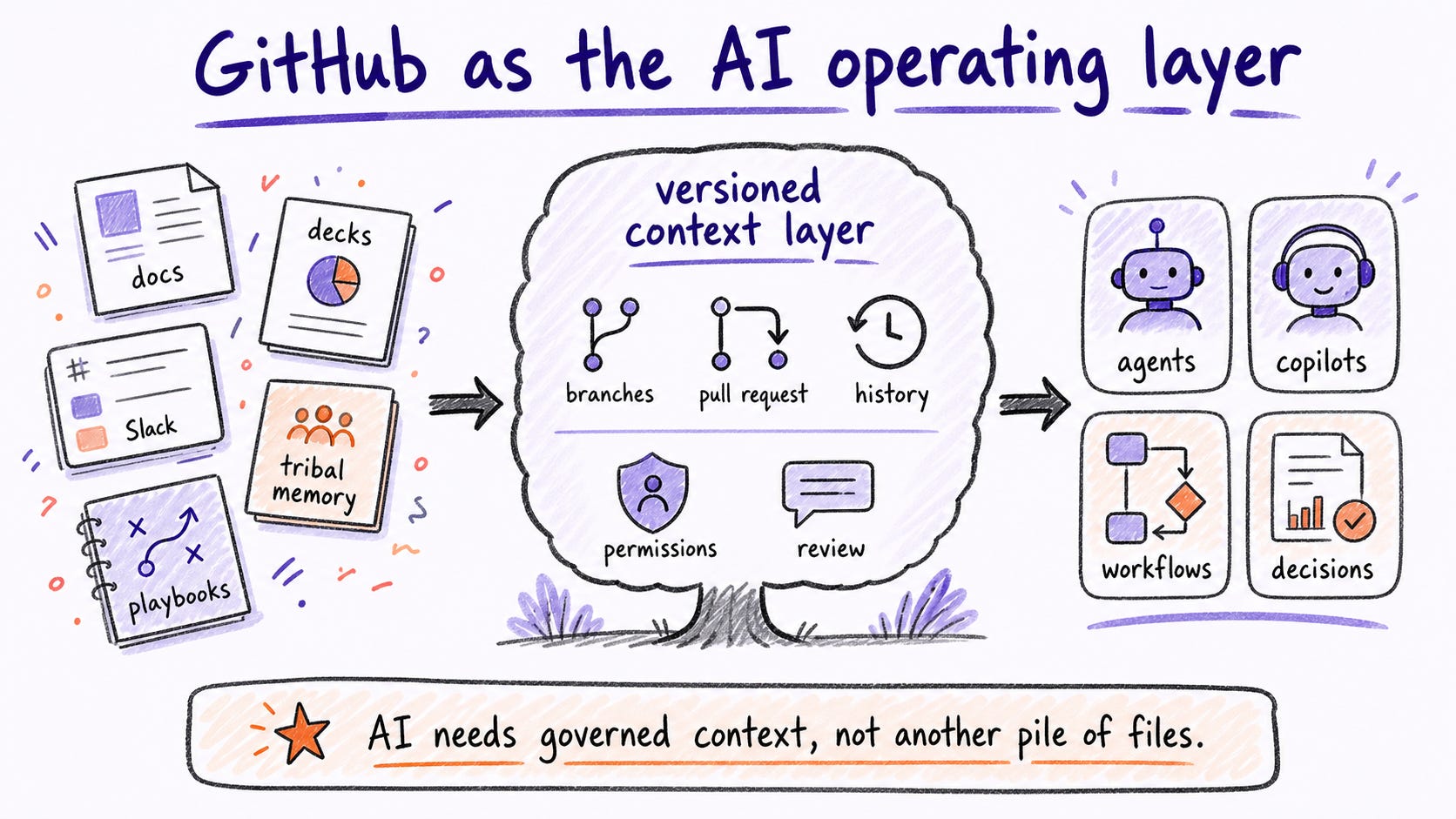
The Missing Layer Is Versioned Organizational Context
The companies that get real leverage from AI will not simply buy more tools. They will build a managed context layer underneath those tools.
That layer needs to do a few things well:
- Hold strategy, priorities, operating models, workflows, and role-level context in one structured place.
- Make changes visible and reviewable.
- Preserve history instead of overwriting institutional memory.
- Let teams branch, test, refine, and merge updates.
- Connect source knowledge to skills, agents, and automated workflows.
In other words, it needs version control.
This is why GitHub is so interesting.
GitHub was built for software. But the underlying model is exactly what organizations now need for knowledge: structured repositories, version history, review workflows, permissions, branches, issues, pull requests, and a clear record of what changed, when, and why.
If you are building an AI operating system for your organization, GitHub is one of the most practical places to start.
Stop Treating GitHub Like an Engineering Tool
Most non-technical leaders still think of GitHub as a place where developers store code.
That is true, but incomplete.
GitHub is really a system for managing change across complex knowledge assets. Code just happened to be the first large-scale use case.
A modern organization has many other knowledge assets that behave like code:
- Strategy documents
- KPI trees
- Operating models
- Role definitions
- Process maps
- Decision logs
- Customer playbooks
- Sales motions
- Product context
- Finance rules
- Legal and compliance guidelines
- Agent instructions
- Prompt libraries
- Workflow specifications
These assets change constantly. They have owners. They need review. They need history. They need to be connected to execution.
That is a versioning problem.
And GitHub is the best widely adopted versioning tool most organizations already have access to.
Build the Organization as a Work Tree
The shift is to stop documenting the organization as a pile of files and start modeling it as a work tree.
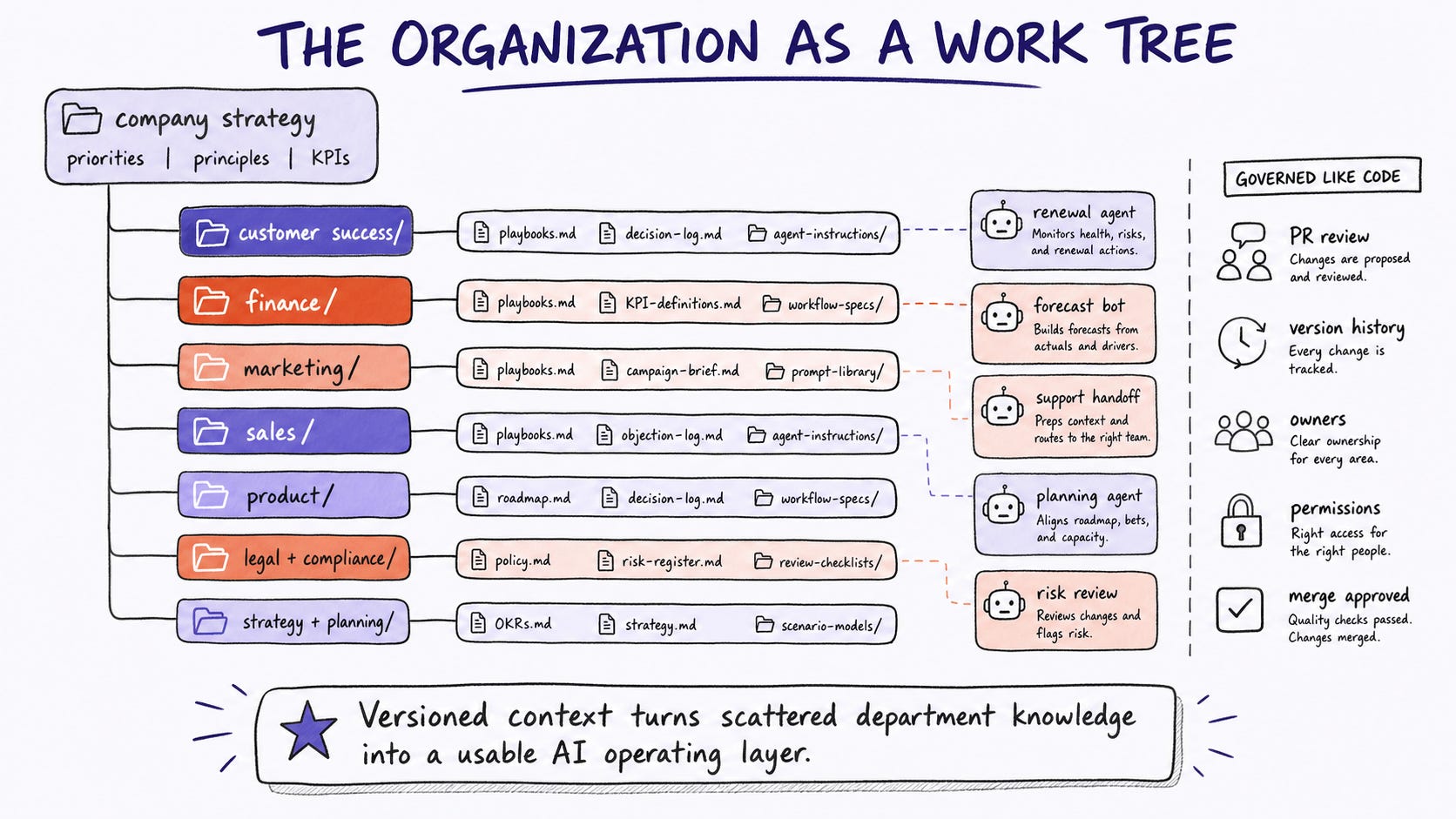
At the top, you have executive strategy and vision:
- What the organization is trying to accomplish
- The strategic bets
- The operating principles
- The company-level KPIs
- The definitions leaders want the business to use
Under that, each function builds its own branch of context:
- Function-level strategy
- KPIs and scorecards
- Operating cadences
- Key workflows
- Decision rights
- Tools and systems
- Cross-functional dependencies
- Team-level playbooks
- Role-level responsibilities
Then each management layer carries that context further down:
- VP-level operating model
- Director-level execution plans
- Manager-level routines
- Individual contributor workflows
- Customer or account-specific context where appropriate
This creates a top-down map of how strategy becomes execution.
It also creates a bottom-up path for updates. When a frontline workflow changes, that change can be proposed, reviewed, and merged back into the source of truth instead of disappearing into a private note or one-off deck.
## Customer Success Is the Perfect Example
Customer Success is one of the best places to see why this matters.
CS teams live at the intersection of product, sales, support, implementation, finance, legal, and the customer. They rely on a huge amount of cross-functional information, and much of it changes quickly.
A strong Customer Success context tree might include:
- Company strategy and customer segment priorities
- CS strategy and retention goals
- Renewal and expansion playbooks
- Account health definitions
- Escalation paths
- Product roadmap context
- Support handoff rules
- Pricing and contract guidance
- Implementation milestones
- Executive business review templates
- Churn risk signals
- Customer communication standards
Today, much of this often lives across disconnected tools. A CSM may need to check a deck, ask a product manager, search Slack, review a CRM note, and rely on memory just to answer a customer question with confidence.
Now imagine that same CS function built on versioned context.
The CSM’s AI assistant can retrieve current product positioning, account health rules, escalation guidance, renewal motion, and customer-specific context from a governed source. A manager can update a churn playbook through a reviewed change. Product can update roadmap messaging once, with the change visible to every downstream agent and workflow that depends on it.
The value is not just better documentation.
It is a more reliable operating layer for human and AI work.
Strategy And Planning Need This Even More
Strategy and planning teams are another strong example because their work sits between executive intent and operational reality.
They translate leadership priorities into plans, metrics, operating reviews, resource choices, transformation programs, and cross-functional execution.
That translation is where many organizations lose clarity.
The executive team may understand the strategy. Functional leaders may understand their plans. Operational teams may understand their work. But the connective tissue between those layers is often thin.
What exactly changed in the strategy?
Which KPI definition is the current one?
Which initiative supports which objective?
Which dependency is owned by which function?
Which tradeoff did leadership already decide?
Which plan is still draft and which one is approved?
A versioned operating repository gives strategy and planning teams a stronger management system. They can maintain the strategic hierarchy, link priorities to KPIs, track decision history, connect initiatives to owners, and keep functional execution aligned with the current plan.
This matters because AI will increasingly sit inside planning workflows. It will summarize performance, draft executive updates, inspect dependencies, identify risks, and recommend next actions.
If the planning context is ambiguous, the AI output will be ambiguous too.
The Real Product Is Not The Repository
The repository is only the foundation.
The real product is an interconnected layer of context, skills, and agents.
Context tells the system what is true.
Skills tell the system how work should be done.
Agents perform specific jobs using the context and skills they are allowed to access.
For example, a Customer Success renewal agent might use:
- The company strategy file
- The CS retention playbook
- The account health score definition
- The renewal communication skill
- The escalation policy
- The customer’s account notes
- The latest product positioning
A strategy planning agent might use:
- The executive strategy tree
- The current KPI definitions
- The annual planning calendar
- The initiative governance model
- The decision log
- The latest functional updates
When these sources are versioned, reviewed, and structured, the organization can start to trust the work produced on top of them.
Without that foundation, every AI workflow becomes a custom prompt wrapped around uncertain context.
This Requires Management Discipline
The hard part is not setting up repositories.
The hard part is changing the organization’s expectation of what knowledge management means.
Leaders need to treat context as an operating asset, not an administrative byproduct. Teams need owners for their context trees. Managers need to maintain their layer of the work system. Updates need review. Deprecated material needs to be archived or removed. Agent instructions need to point to the source of truth instead of private prompt fragments.
This is not about forcing everyone to become a software engineer.
It is about borrowing the management discipline that software teams developed because they had no choice. When many people change a complex system at the same time, you need structure. You need review. You need history. You need a way to know what is current.
AI is making the rest of the organization face the same problem.
The AI Operating System Starts With Source Control
The phrase “AI operating system” can sound abstract. It becomes much more concrete when you define what the system actually operates on.
It operates on context.
It operates on instructions.
It operates on workflows.
It operates on decisions.
It operates on the accumulated knowledge of how the organization creates value.
That knowledge needs a home.
For many organizations, GitHub may be the most practical home available. Not because it was designed for HR, Customer Success, finance, or strategy teams. But because it was designed to manage versioned knowledge in complex environments where changes matter.
That is now every organization.
If you want AI to become more than a collection of disconnected tools, start by asking a simpler question:
Where does the organization keep the source of truth that AI is supposed to use?
If the answer is scattered across drives, decks, chats, and memory, the operating system is not ready.
Put the knowledge under version control.
Then build the agents on top.